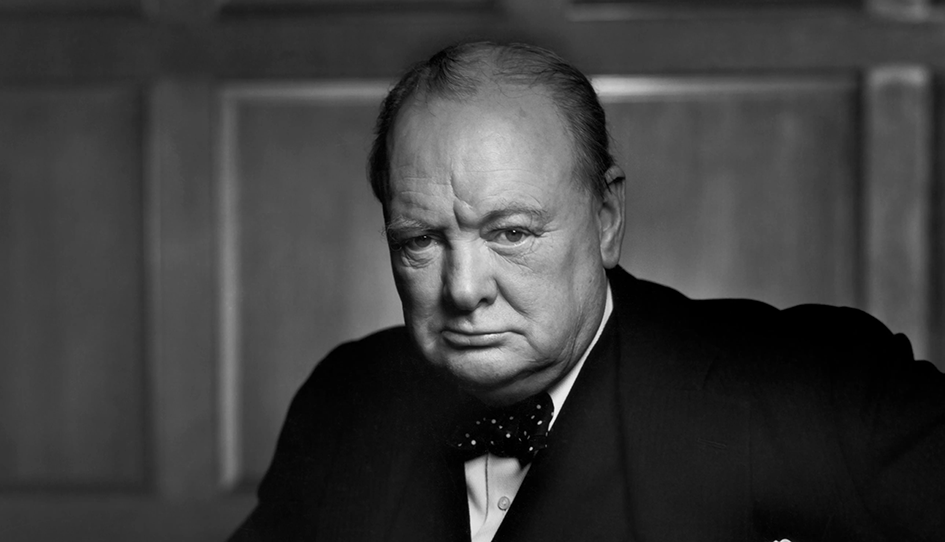
According to a prominent woman writer on the London Evening News, “Sir Winston Churchill will spend his time from now on, in heaven, painting. Children who look up and see a rainbow in the sky will know that Sir Winston is at work.”
Similarly, on the day the old man died, another Fleet Street veteran wrote “even the gale knew the game was up. Swirling away past the chimney pots, it faded, in deference to eternal greatness.”
Half the nation watched the funeral. Half the nation observed the fantastic conceptions of imperialism so skilfully manipulated by the decorated relics of the British Raj. Though many workers remained unimpressed, notably Nottinghamshire County Councillors who refused point-blank to stand in silence for his memory, there must be several who still believe that the reactionary rogue that was Winston Churchill made some contribution to their well-being. That is the danger of the slagheaps of slick drivel erected in his memory, and they need to be met at once with the full force of facts.
When Winston Churchill was still at Harrow, a master asked him what he would do when he grew up. The young Winston replied: “I shall join the army, if there’s any fighting to be had. Otherwise, I shall have a go at politics.”
No statement has got nearer to the truth about Churchill. The most important aspect of his character was that he loved war. He revelled in the sound of battle and the glory of victory. He was never really happy unless fighting. During wars he rose to the height of his capacity. When he smelt a war his nostrils twitched in delighted frenzy. In peacetime he was moody, fitful and depressed.
Patriotic wars brought him enormous pleasure. He loved the fine phrases of meaningless patriotism. Yet in patriotic wars he could never really HATE the enemy. He could abuse him with all the oratory at his command… but the abuse was superficial. Real, genuine hatred only came to him during his favourite war – the class war.
Thus as a Liberal Home Secretary before the First World War, he joyfully mustered his troops to smash the miners and the railwaymen in Wales. He delighted the coal owners with his frank devotion to “law and order.” In the square of Tonypandy he demonstrated his class solidarity with truncheons and bullets.
Forcible feeding of Suffragettes in the prison was one of his more original notions. When some Anarchists sought refuge in a house in Sydney Street, he donned his uniform, and slobbering with pleasure at the sheer melodrama of the situation, personally ordered the firemen to leave the fire alone so that the Anarchists could burn to death.
As First Lord of the Admiralty in the First World War, he dreamed of the dramatic capture of Constantinople. These dreams cost 50,000 workers their lives, and another 250,000 serious injury. Churchill was excited by this slaughter into defending his romantic gestures in the Dardanelles, long after his removal from the Cabinet.
Thrown out of the Cabinet, he went himself to France. If he couldn’t direct the war, the next best thing was to smell the blood of massacred workers in the trenches himself. When the war finished, lo and behold, there was another war – for him, far more vital – the war against Bolshevism.
Churchill loathed the Bolshevik Revolution. He saw in it the seeds of the working class power he so dreaded. He was later to become a great friend of Stalin, in whom he found the same bestial delight in glamorised violence. Yet against Lenin and Trotsky he launched the full force of his flatulent venom.
The following passage on Trotsky amply demonstrates the sheer political illiteracy of the man: “He (Trotsky) fumed, growled, snarled, bit and plotted against the rich. He had raised the penniless against the poor. He had raised the criminal against the penniless. All had fallen out as he had willed. But nevertheless, the vices of human society required it seemed new scourgings. In the deepest depths he sought with desperate energy for a deeper. But poor wretch – he had reached rock bottom. Nothing lower than the Communist criminal class could be found. In vain he turned his gaze upon the wild beasts. The apes could not appreciate his eloquence. He could not mobilise the wolves, whose numbers had so notably increased during his administration.”
Churchill did all he could to persuade British workers to annihilate Bolshevik Russia. With strikes and demonstrations they refused. Churchill could repay them in kind when he became Chancellor of the Exchequer in 1924. His decision then to place Britain on the Gold Standard was, as Keynes explained, and he himself well knew, a wage cut for every British worker of two shillings in the pound.
In 1926, he directed himself with renewed vigour against his old enemies, the miners, isolating them with skilful precision and smashing them into the ground. Nothing delighted his savage temperament more than the sight of the defeated miners, trudging, wearily and disillusioned, back underground.
Yet his failure to defeat Bolshevism by force of arms still rankled. He rejoiced to see men gaining power in Europe whose dedication to the cause of wiping out the socialist threat was as great as his.
In January 1927, Churchill visited Rome. After being wined and dined at the court of Mussolini, he made the following statement to the Rome Press:
“I could not help being charmed, like so many other people, by Signor Mussolini’s gentle and simple bearing and by his calm, detached poise in spite of so many burdens and dangers.
“Secondly, anyone could see that he thought of nothing but lasting good, as he understood it, of the Italian people, and that no lesser interest was of the slightest consequence to him. If I had been an Italian, I am sure that I should have been wholeheartedly with you from start to finish in your triumphant struggle against the bestial appetites and passions of Leninism. That we shall succeed in grappling with Communism and choking the life out of it – of that I am absolutely sure.
“I will however say a word on an international aspect of Fascism. Externally, your movement has rendered a service to the whole world. The great fear which has always beset every democratic leader or working class leader has been that of being overbid by someone more extreme than he. Italy has shown that there is a way of righting the subversive forces which can rally the mass of the people, properly led, to value and wish to defend the honour and stability of civilised society. She has provided the necessary antidote to the Russian poison.”
This was no shot in the dark, no aberration. During the Spanish Civil War, for instance, Churchill vehemently supported Franco’s Fascism and went so far as to pay tribute to Franco’s main aide – Adolf Hitler:
In 1935, for instance, he wrote: “The story of Hitler’s struggle for the German heart cannot be read without admiration for the courage, the perseverance and the vital force which enabled him to challenge, defy, conciliate or even overcome all the authorities or resistances which barred his path.” And two years later, at the height of the Spanish conflict, he wrote: “One may dislike Hitler’s system and yet admire his patriotic achievement. If our country were defeated I hope we should find a champion as admirable to restore our courage and lead us back to our place among the nations.”
Churchill did not have time to expand on his “admiration” for such men as Hitler and Mussolini For already the blast of war was blowing in his ears. He urged rearmament, not from principle, but because he liked armaments and he loved wars. He was not going to let the chance of a world war slip through his fingers, even if it meant fighting against Hitler.
Certainly, this particular war gave him everything he wanted. A united people, always ready to cheer. A magnificent military come-back from near disaster. Hundreds of opportunities to vent that vacuous, pompous oratory for which he is so well known.
1945
Everything? – almost. It did not give him the class victory he would so have loved. When electioneering in 1945, he rode through Glasgow in a Conservative motor cavalcade, the workers thronged the pavements booing and giving the V-sign the wrong way. The brutality of the war, so relished by Churchill, had galvanised the workers’ consciousness. They understood now that Churchill was simply “one of the others.” That Churchill had fought the war for the love of blood and thunder and for his own ruling class. Once it was over, he had tried in every possible case to restore the class status quo.
Thus conscious, the workers booed and cat-called. With a mighty vote they flung him into the political wilderness.
It says something for the decay of politics, for the Labour bureaucracy and for real fears for the future that today this monstrous, battle-hungry thug is hailed as the greatest Englishman who ever lived.
There has not been such a ludicrous, dangerous display of idolatry since Winston’s great friend, Stalin, died twelve years ago.