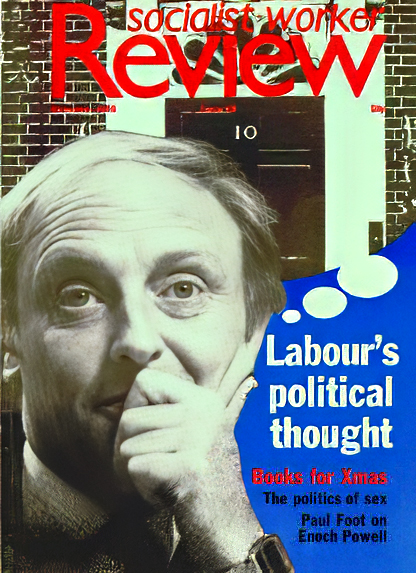
In 1986, Paul joined the editorial board of Socialist Review, the SWP’s monthly publication. He wrote for it regularly, and when he died, a special edition was published that included several of the most memorable pieces he had written
Paul Foot: A Tribute, includes the following articles:
“…if the power of the people who do the work can be organised against those who profit from it, a real prospect opens up”
Born Unfree and Unequal
April 2003
Capitalism’s claim of promoting democracy is continually undermined by the growing gap between rich and poor.
In his speech in the House of Commons debate on war with Iraq, Tony Blair allowed himself a rather rambling excursion into what he saw as the basic reasons for the conflict.

Paul argues that spontaneous activity is not enough – we need collective organisation
The Workers’ Movement: The party’s just begun
January 2002
‘We are many – they are few.’ With that historic reminder, the poet Shelley ended his furious poem about the massacre of trade unionists at Peterloo. The line has been quoted (well, misquoted really, since Shelley, in self imposed exile in Italy, wrote, ‘Ye are many – they are few’) a million times since.
In 1984, the miners led a titanic battle against the Thatcher government, and went down to a terrible defeat, not because the strike happened but because the other side was better organised and better prepared
Remembering the miners’ strike
1985
On 1 March 1984 Margaret Thatcher and her ministers embarked on a class battle. It was to be as tough and crude a class battle as had ever been attempted – even by Margaret Thatcher’s beloved Victorians.
A talk on the 200th anniversary of the slave revolt in the French-owned island of St Domingue – now known as Haiti. A revolt whose repercussions challenged the very being of colonial slavery
Toussaint Louverture: the Haitian Slave Revolt of 1791
July/August 1991
Well, we are playing once again the anniversary game here, 1791 to 1991. There was a very good example of that the other day, I don’t know whether you saw in the newspapers, that her Royal Highness…
A strike at Timex had become a symbol of resistance for all workers. Paul visited the picket line in Dundee, talked to strikers and drew some lessons from the dispute
Seize the time
June 1993
We socialists are always saying that workers change in struggle – but what a joy and a relief it is when we can test the theory in flesh and blood. When I drew back the curtains in Tayport at 6.30 a.m. on Thursday 20 May, the sun streamed in…
The Scott report, the result of the judicial inquiry into arms sales to Iraq by British companies, revealed the extent of government collusion with the arms industry
Armed and dangerous
March 1996
So prolonged and extensive was the hype which heralded the Scott Report that an anti-climax was almost inevitable. The government’s approach to the report of the inquiry, which it set up itself, was twofold.
The overwhelming response to the revolts that swept Russia and Eastern Europe from 1989 was that socialism was dead. How should Marxist’s interpret those events?
Marx’s real tradition
March 1990
THE TUMULTUOUS revolts in Eastern Europe have divided socialists into two camps. In one camp there is gloom and introspection. In the other there is excitement and delight.
The root of the reason why Catholics and Protestants were fighting each other during the troubles in the north of Ireland lay in the role played by the British government in the creation of Northern Ireland.
Dividing Ireland
July/August 1988
THE REALITY of human existence in Ireland over the last few centuries has been dominated by the British Empire. Ireland is the oldest colony in that empire. Marx summed up the nature of that long imperial rule in a single sentence:
The great Scots writer Lewis Grassic Gibbon was born 100 years ago this year. Paul Foot looks at the work of this champion of change
Lewis Grassic Gibbon – Poet of the granite city
December 2001
Many, many years ago, way back in 1975, I was working full time as a reporter on Socialist Worker. That was the best job I ever had because I could integrate what I wrote with what I thought.
Shakespeare’s Coriolanus is the best political play every written, although Paul didn’t think much of the production he was reviewing
Tribunes and the people
January 1990
“SHAKESPEARE was a Tory without any doubt”. Thus Nigel Lawson, in what must rank as one of the Great Asininities of the 1980s, in an interview in the Guardian in September 1983.
Marking 200 years since the birth of the poet Shelley.
Poetry of Protest
July/August 1992
SHELLEY WAS BORN 200 years ago, and all over the world he will be celebrated in two very different ways. Those who honour him as a ‘great lyric poet’ will put him on a pedestal and pay him homage.
Paul became a Marxist in Glasgow in the early 1960s. He bought pamphlets and books from one of its left-wing bookshops and remembered that introduction to Engels and his revolutionary pamphlet Socialism: Utopian and Scientific in this review.
Vision of a new world
May 1993
When I first read this little book 32 years ago, the strongest force on the Marxist left was the Communist Party. I expect I read it very much as the Communists presented it.