Colin Wallace was a press officer for the British Army in Northern Ireland, whose move into intelligence ended badly. Colin says he was thrown out of the army for refusing to take part in an MI5 dirty tricks campaign against British politicians, and for trying to stop horrific child abuse at the Kincora Boys’ Home. He says he was framed for a murder he didn’t commit when he refused to keep quiet. The Government’s response was – he’s making it all up.
‘That’s what Colin Wallace says,’ Paul wrote in his first column about Wallace’s case. ‘It is fantastic. But is it true?’
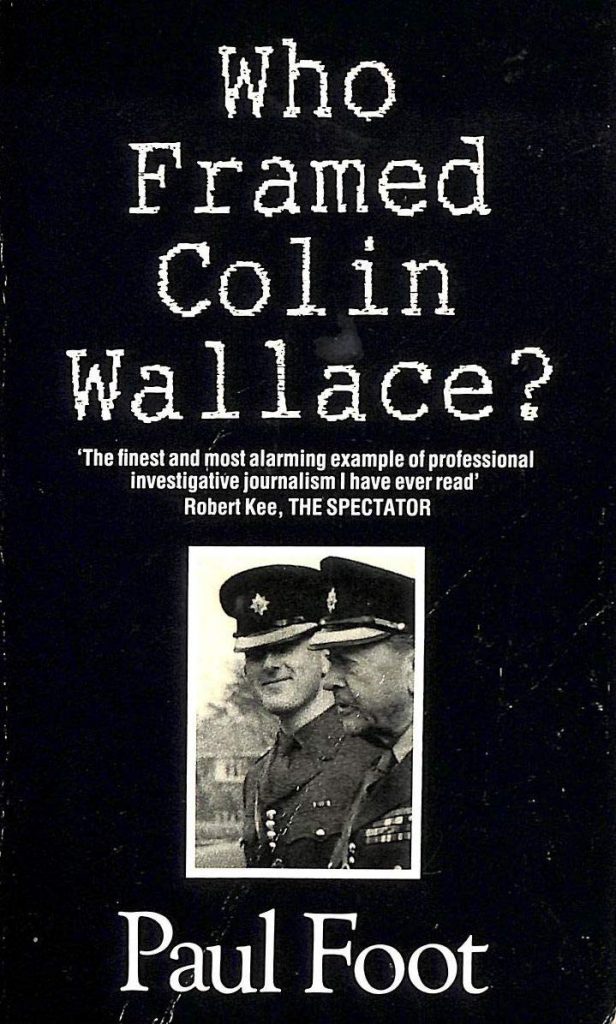
Paul was fascinated by the story, but he realised very quickly that he simply did not have enough space in the Mirror to do it justice. He would need to write another book. Macmillan agreed to publish but, because of its sensitive nature, kept the project a secret. Paul signed the contract for the book in the summer of 1987 and worked on it throughout 1988.
The deadline for the book suddenly took on a new urgency in early 1989. In the wake of the Peter Wright scandal, the Conservative government was busily pushing through parliament a new, tighter, broader Official Secrets Bill, which would make it risky for any journalist who talked to a source in the security service. The Bill was due to become law in early May 1989. Could Paul finish the manuscript by the end of March? At that point the book was still only half-written.
A highly secret project, code named Operation Weasal, got under way at his publisher’s. No one was to talk about it over the phone. All copy had to be delivered by hand, not by post or messenger. There was good reason for the caution: the smaller the number of people involved, the smaller the number at risk of prosecution, if that ever arose.
In the first week of April, Paul delivered his finished manuscript and the circle of people in the know widened, slightly. Publication of Who Framed Colin Wallace? was planned for 9 May.
A handful of individual copies of the book were distributed discreetly. The Daily Mirror was given one so that it could carry a long article on publication day and a handful of copies went to politicians who had a direct interest in the story. Bookshops were sent unordered copies, marked as only for sale on 9 May, and with a note inside apologising for the secrecy and asking them not to return the unsolicited order.
No review copies were sent. No advance press release was issued. On the morning of publication day, journalists were invited to a press conference with Paul and Colin at midday.
The new Official Secrets Act came into force two days later.
Of all the reviews that appeared, perhaps the most significant was one written by Anthony Cavendish for the Sunday Times. Cavendish had worked for MI6, he’d met Wallace, and duly been warned against him, just like everyone else: ‘I believe him and the story which Foot has now documented. I have always believed that the intelligence services (in themselves a sort of freemasonry) could, both by using the old boy network and claiming national security interests, get anything done, or achieve any result in this country.’
The book, he said, would be an irritant to the government – and it was.
It was also an extremely good read, a traditional whodunnit, with the involvement from politicians of both main parties, the police, the security services, the armed services and the law.