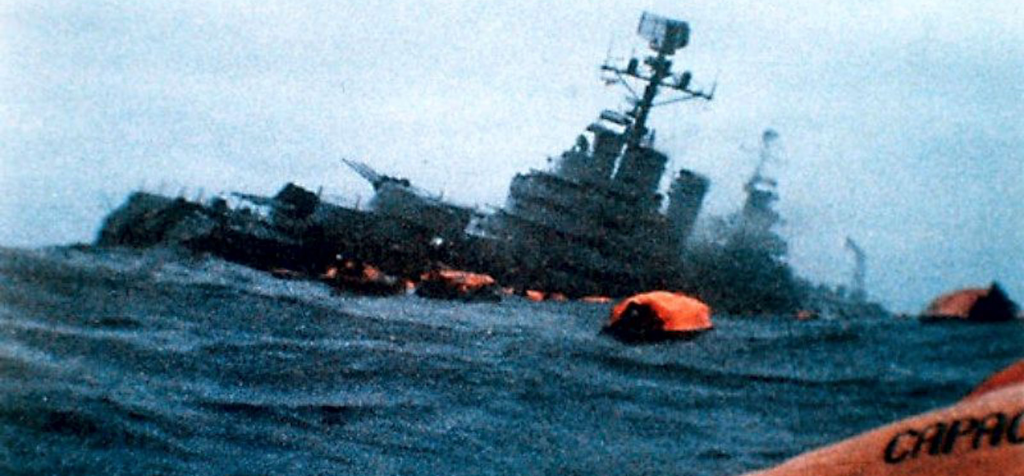
DID MRS THATCHER order the sinking of the aged Argentine cruiser General Belgrano, on Sunday 2 May last year, in order to scupper a peace settlement which had been hammered out between Lima, Peru and Washington over the previous weekend and which was on the point of being signed? For several months, Tam Dalyell, the Labour MP for West Lothian, has been making this astonishing charge against the Prime Minister. His view is that she deliberately gave the order to sink the cruiser at a time when an honourable peace settlement was almost secured – one which could have prevented the subsequent bloodshed of the Falklands campaign.
The charge has been met in the main with faintly amused disdain. Tam Dalyell, it is pointed out, is an eccentric with weird views on many subjects. But whenever a specific reply has been given to any of his questions, the mystery surrounding the sinking of the Belgrano has deepened. The 45-year-old cłuiser was not ‘closing on the Task Force’, as Defence Minister John Nott told the House of Commons at the time. It was heading away from the Falklands and was at least 350 miles from the nearest task force surface ship. The range of its guns was 13 miles. Even its missiles would hardly have reached into the ‘exclusion zone’ established round the islands. After spending four days in Lima and talking to Dr Javier Arias Stella, Peru’s Foreign Minister at the time, the picture I got strongly confirms Dalyell’s charge.
Thursday 29 April The Organisation of American States, the alliance which binds North and South America, met to consider the Falklands crisis. It passed a motion proposed by Peru which called for a ceasefire and a peace on the basis of recognising Argentina’s sovereignty over the Falklands. Several countries, including the United States, abstained.
Friday 30 April United States Secretary of State Alexander Haig declared that his efforts to get a peace settlement between Britain and Argentina had failed. He had tried to reach an agreement on the basis of United Nations Resolution 502 – which called for Argentine withdrawal followed by negotiations. His stumbling block was that the British would sign nothing which did not include immediate Argentine withdrawal from the Falklands and the Argentines would not withdraw unless their rights to the islands were sanctioned. It seemed a hopeless impasse.
Haig declared, moreover, that the United States supported Britain in the conflict, and would assist economically and militarily.This statement was greeted with fury in Peru, which has close ties with Argentina.
Saturday 1 May The British forces attacked Argentine positions on the Falklands by sea and air. The barrage included a hail of cluster bombs. The Argentines admitted to 56 dead. There were probably many more.
In Lima, that evening, the ageing President Belaunde Terry and his Foreign Minister, Dr Arias Stella, held urgent talks. They decided to intervene to seek a settlement. Belaunde rang Washington and spoke at length to Haig, offering to act as broker in new peace negotiations. Haig leapt at the suggestion. He had not given up hope of a last-minute compromise. Moreover, he was about to welcome the British Foreign Secretary, Francia Pym, who was flying into Washington that evening. In the frenzied negotiations over the next two days, the Peruvians ‘acted’ for the Argentinians and Alexander Haig for the British.
At once, Haig told Belande that any new proposals, if they were to have the slightest chance of succeeding, must move a long way from what had been previously rejected. He suggested (to satisfy the main Argentine objection) that no position on sovereignty should be adopted, but that a treaty should recognise the ‘conflicting claims’ of both countries; and (to reassure the British) a separate clause to sanction the ‘points of view and interests’ of the islanders.
If these two clauses could be agreed on both sides, he thought that a peace was possible on the basis of an instant ceasefire, withdrawal of all forces, an interim administration of the Falklands that involved neither Argentines nor British, and a ‘contact group’ of four countries – then suggested as the US, Peru, West Germany and Brazil – to supervise the withdrawal and the negotiations. The last point was that agreement would have to be reached by 30
April 1983.
The seven-point plan was not agreed with Haig until nearly midnight. At once Belaunde phoned the Argentine dictator Leopold Galtieri. Galtieri was delighted with the new initiative. The day’s attacks on the Falklands had frightened him and his high command. They were now facing a humiliating defeat. He assured the Peruvian President that the new proposals satisfied him. Would they not remove the British from the Falklands without any more shots being fired? And did they not at least accept that Argentina had a claim to sovereignty? He would talk to his high command in the morning, he promised; but he was hopeful.
Sunday 2 May That optimism was increased considerably when Galtieri phoned Belaunde in the early morning. The high command, he said, was almost unanimous in approving the terms, though there were a number of small points to be negotiated.
Throughout that morning, Belaunde negotiated these points in calls to Washington and to Buenos Aires. In Washington, General Haig was in close touch with Francis Pym (he was probably in the same room for most of the time – certainly the two men had lunch together). In Buenos Aires, Galtieri kept open his hot line to the junta’s hard man, navy chief Admiral Anaya.
The proposals were amended. ‘Points of view and wishes’ of the islanders was changed to ‘needs and aspirations’. The membership of the contact group was left open, though it was suggested that Canada might come in for the US and Venezuela for Peru.
By noon, an agreement seemed secure. A final draft of a treaty was prepared by officials who had been at work in the 18th century Torre Tagli mansion (the headquarters of the Peruvian Foreign Office) since the early hours. It was drawn up for signature by the British and Argentine Ambassadors in Lima. The ceremony, it was confidently expected, would take place that night.
General Galtieri, who had given the go-ahead for these preparations, made it clear that he must first get the approval of his official junta meeting, scheduled for 5pm that afternoon. But, he insisted, the agreement of the junta was a formality.
This is confirmed by the Sunday Times Insight book on the Falklands war, which quotes a ‘senior official’ of the Argentinian Foreign Ministry as saying, ‘I was in the room when Foreign Secretary Costa Mendes came in and said: “We have an agreement. We can accept this”. Everybody was very excited.’
Once the junta meeting started in Buenos Aires, President Belaunde decided to hold his weekly press conference, which had been long delayed. At 4.45pm, he went in front of the cameras with his Prime Minister and Foreign Minister to tell the world that a settlement was at hand ‘this very night’. All three men made it quite plain that a settlement was imminent.
Very soon after the press conference, these high hopes were dashed. News came in of the sinking of the Belgrano some three and a half hours earlier (it was sunk at about 4pm Argentine time, 2pm Lima time). Communications were slow, since the cruiser’s signalling systems were destroyed and its escorts and the submarine wanted to protect their positions.
An admiral stormed into the junta meeting in Buenos Aires shouting the news. Many junta members had sons and nephews on the Belgrano. The method of its sinking and the huge loss of life completely changed the mood of the meeting. Although they went on formally discussing the proposals, all hope of a settlement was dead. The State Department was the first to convey the bad news to the Presidential palace in Lima.
At 6.30pm, Foreign Minister Arias Stella received the Ambassadors of Britain (Mr
Charles Wallace) and Argentina (Mr Louis Sanchez Mareno). Perhaps they came to sign the treaty. They were told the bad news and left.
Soon after midnight, after a seven-hour meeting, the junta formally rejected the Peruvian peace proposals, specifically mentioning the Belgrano sinking as the cause.
DURING THE NEXT FEW days, the Peruvian President, Prime Minister and Foreign Minister all explained to the Peruvian Parliament that peace had been in their grasp, only to be sunk with the Belgrano. All three endorsed the unequivocal view of the Prime Minister, Mr Manuel Ulloa Elias: ‘Argentine rejection of the Belaunde peace proposals was due to the fact that Argentina had been attacked with the torpedoing of the Belgrano at the very moment that Peru was
trying to find a dignified way out of the contest.’ (Quoted in El Observador, Lima, 5 May 1982.)
Ulloa also strangely rejected the widely held view that the Belaunde proposals were just a re-hash of Haig’s earlier efforts – ‘Haig in a poncho’. On the contrary, he said, the package was very different both from the Haig proposals, which failed because they leant too far to the British, and from the OAS resolution of 29 April, which leant too far to Argentina. In the Belaunde proposals, unlike both the Haig and the OAS, an immediate Argentine withdrawal was matched by the temporary removal of British administration from Port Stanley; and the matter of sovereignty was left entirely neutral.
The Belaunde proposals, it is safe to conclude, were taken seriously by both sides. They were drawn up into a treaty which was expected to be signed. And they were put to flight by the sinking of the Belgrano.
Señor Arias Stella, who is a fellow of the Royal Society of Pathologists in London and has no anti-British feeling, generously ascribes the Belgrano sinking to military accident. He told me that he and all his colleagues had assumed that some hothead submarine commander had let Bly at the cruiser without any idea of the state of negotiations, in Lima, Buenos Aires andn Washington.
This has been indignantly denied by the submarine commander himself. He insists he received clear orders to sink the cruiser.
Nor have Tory Ministers been slow to claim their part in the action. Margaret Thatcher told the House of Commons on 4 May last year: ‘With regard to that particular event [the sinking of the Belgrano) and all events other than the mere tactical ones in the South Atlantic, the task force clearly is and was under political control.’
A few minutes later, Nott, the Defence Secretary, was asked by Willie Hamilton: ‘Will the Minister confirm … that the decision to launch the torpedoes was a political decision – in other words, it was made either by the Prime Minister or by the Rt Hon gentleman, or by both together? Or was it made by an admiral on the spot?’ Nott replied, rather evasively: ‘The overall political control remains with the government.’
There the matter rested until last October, when a mysterious leak to the newspapers (printed in all of them) ‘revealed’ that the decision to sink the Belgrano had been taken by the ‘war cabinet’ (minus Pym) in pre-lunch discussions with the service chiefs on 2 May.
This version comes out in The Battle for the Falklands by Simon Jenkins and Max Hastings as follows: ‘Sir Terence Lewin went to the war cabinet meeting at Chequers on the morning of Sunday 2 May to request permission under the rules of engagement to sink the General Belgrano some 40 miles South West of the total exclusion zone.’ After some discussion the book goes on: ‘No Minister demurred. The order was issued before lunch.’
One difficulty about this is that the cruiser was not actually sunk until about eight hours afterwards (between 3 and 4pm Argentine time – 8 and 9pm GMT). Even given the difficulties of contact with a submerged submarine, this does seem a huge time gap.
Another problem is that the war cabinet meeting with the defence chiefs was not just a discussion about the Belgrano. It was, as reported in the newspapers on 4 May, a full-scale assessment of the state of the war, which went on for four hours.
At any rate, the direct responsibility of Thatcher, Whitelaw, Nott and Parkinson for the Belgrano sinking has never been denied. The question then arises: how much did they know of the progress of the Peruvian peace talks?
THE SEVEN-POINT PLAN had been agreed between Haig and Belaunde the previous night (in Britain, the early hours of the morning). Was it conveyed to Chequers that night? Did the war cabinet meeting not have before it ‘the latest from Francis in Washington’? Even if they did not, they knew that Pym had gone to Washington in a last bid for peace. However hopeless such a mission seemed in the eyes of the hawks in the war cabinet (and by all accounts they were all hawks, except Pym), they knew that the armed forces could not be seen to cut the ground from under the Foreign Secretary’s feet.
On arrival in Washington the previous evening, Mr Pym gave an impromptu press conference. He explained that the attacks on the Falklands that day had been intended to concentrate the Argentines’ minds on a peaceful settlement. He went on: ‘No further military action is envisaged at the moment, except to keep the exclusion zone secure.’ (Times, 2 May 1982) This pledge was kept – right up until the sinking of the Belgrano.
At the very least, then, the Cabinet that Sunday morning knew that Pym was trying for peace and that a period of calm was vital if he was to be seen to be trying. That is the background, apparently, in which they gave the order to attack a ship on the high seas, with a complement of 1,000 men, when it was outside the war zone they themselves had designated.
As the afternoon and evening went on, however, Mrs Thatcher and those Ministers who stayed in contact can have been left in no doubt as to the progress of the Peruvian peace talks. By noon US time, 5pm GMT, after all,, the seven-point plan had been agreed between Belaunde, Haig and Galtieri. Even before he sat down to lunch with Haig, Francis Pym must have known about this, and expressed his own agreement. He must, too, have conveyed it back to Chequers. If the order to sink had in fact been given at lunchtime, there was still time to countermand the order, or to try to countermand it. For the Belgrano was not sunk until three hours later.
The British government does not deny that it was prepared to accept the Belaunde proposals. The Official Foreign Office document, ‘The Falklands Islands: Negotiations for a Peaceful Settlement’, published on 20 May last year, says: ‘The next stage of the negotiations was on proposals originally advanced for President Belaunde of Peru and modified in consultations between him and the United States Secretary of State … Britain was willing to accept the final version of these proposals for an interim agreement, but Argentina rejected it.’ The document does not point out that Argentina rejected it under the most savage provocation imaginable, namely, the sinking of the Belgrano.
If the interim agreement had come into force, what would have happened? All forces would have withdrawn. A thousand lives (and several thousand million pounds) would have been saved. The British forces would have left the Falklands for the time being. Some sort of settlement respecting the needs and aspirations of the islanders would probably have been reached. Not everyone would have been satisfied, but at least the Falkland Islands would have had a future as a place where people lived and worked, not as a military bunker.
The only organisation seriously undermined by the settlement would have been the British Conservative Party. Its press and its right wing had been let off the leash. Only war and conquest would have satisfied them. For the Iron Lady, donning the ill-fitting garments of peace and compromise, the future would have been bleak indeed.
Tam Dalyell’s questions stand up well to the facts. They were not even asked by the Franks Report. Franks and his colleagues stopped at the Argentine invasion. If they had asked why the war was allowed to start; in particular, who gave the order to sink the Belgrano; when; above all, why – then I doubt whether Margaret Thatcher would have read their conclusions to the House of Commons with such gusto. For the sinking of the General Belgrano was, at best, a crass blunder, based on false information, which made a laughing stock of Pym’s negotiations. At worst, it was, as Tam Dalyell suggests, a desperate fling to force the other side back from a peace treaty which could have sunk the Tory leadership.