Paul was brought up in a family of political Liberals although his Uncle Michael, considered the renegade of the family, was a Labour MP, first in Plymouth and then for Ebbw Vale – Aneurin Bevan’s old seat.
Paul’s own political ideas were gradually clarified at Oxford, where he met two people who would have a considerable influence on him. One was Stuart Hall, the first editor of New Left Review. Hall was a Jamaican, so there would have been an immediate interest and affinity when they met. The other was Colywn Williamson, a politics don who ran a Marxist study group, to which he invited anyone he thought might be attracted to socialist ideas. They remained friends, as well as comrades, for the rest of their lives.
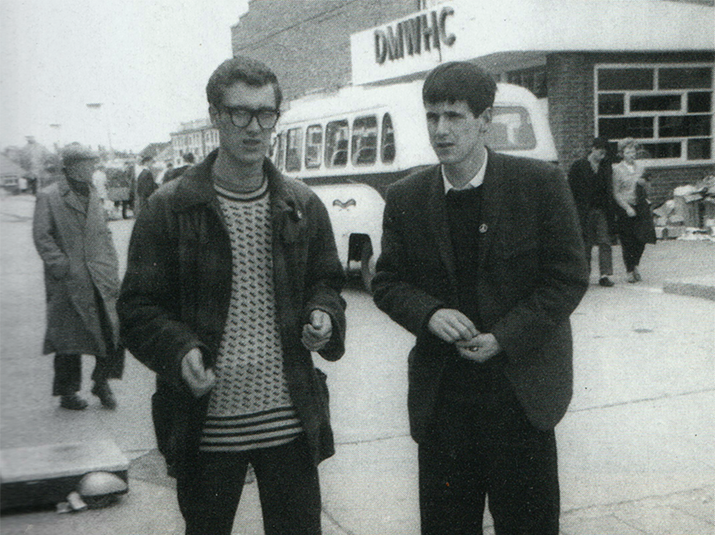
Paul with Gus McDonald
Paul’s change in political beliefs might have begun in Oxford but it was forged in Glasgow, where he learned a thing or two about political debate, standing on a soap box on Sauchiehall Street, or seated among the young workers, male and female, in the Govan and Gorbals Young Socialists.
Again, there were two people in particular who had a profound influence on him. The first was a young engineering apprentice in the shipyards called Gus MacDonald, who took Paul along to those meetings of the Govan and Gorbals Young Socialists (the Labour Party’s youth organisation). Gus was an agitator and had played a key role in the Glasgow apprentices’ strike the year before they met. But he was also a working class intellectual, a reader of Marx and the philosophers. It was through Gus that Paul met Tony Cliff and in 1962 joined the International Socialists. He was still a member when he died in 2004.
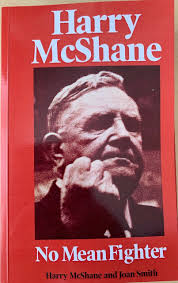
The other great influence in Glasgow was Harry MacShane. Harry was already 70 when he and Paul first met, with a political pedigree that went back decades. He had become a revolutionary in 1908, an organiser for the Unemployed Workers’ Movement in the 1920s, a member of the Communist Party in 1923 and a journalist for the CP paper the Morning Star. He left the CP in 1954, which meant giving up his job on the Star, and, although he was already aged 61, he returned to the shipyards as a labourer until he had worked for long enough to earn a pension.
The two would meet in the Gondola Café in the Gorbals and discuss history and politics for hours. Even though he was in his seventies, Harry insisted Paul go with him to the meetings of Glasgow Trades Council – which brought together trade unionists from across the city – as well as meetings at factory gates or other towns and cities in Scotland.
Although they agreed about much, and Harry was on the Labour Worker editorial board when Paul edited the paper, he did not join Paul in the International Socialists. In his politics, Harry was closer to Raya Dunayevskaya, a Russian-American Marxist and former secretary of Trotsky. Based in Chicago, the British section of her group called itself the Marxist Humanist group, and had just three members, all trade unionists, who had all left the CP at the same time.
In Glasgow, Paul read everything he could find: books about the German revolutionary Rosa Luxemburg; the writings of Lenin and Trotsky; the vast biography of Trotsky by Isaac Deutscher. There were several books that Paul claimed, at different times, had changed his life. One was Ralph Miliband’s Parliamentary Socialism, ‘It put me off my plan to be a Labour MP for life.’ Another was a slim volume by Marx, The Civil War in France, written in 1871, just after the defeat of the Paris Commune. ‘In one blow’, Paul told an audience at a meeting about the Commune, ‘this book smashed all my exciting parliamentary ambitions. It was quite obvious to me that there was no point whatsoever in engaging in such activity.’
No doubt, when he left Oxford, becoming an MP had been very much on his mind.
There was one other person he first met in Glasgow, who had a significant impact on his life and his political thinking: Tony Cliff, the founder along with his brother-in-law Mike Kidron, of the tiny organisation that would become the International Socialists and then the Socialist Workers Party. The two had come to Glasgow for a weekend school organised by Gus, to discuss, among other topics, a matter of particular importance to the Left in general and the Left specifically in Glasgow, at the time: could Russia be described as a socialist state? No, argued Cliff, it was not socialist but state capitalist, the state having taken over the role of a class of individuals.
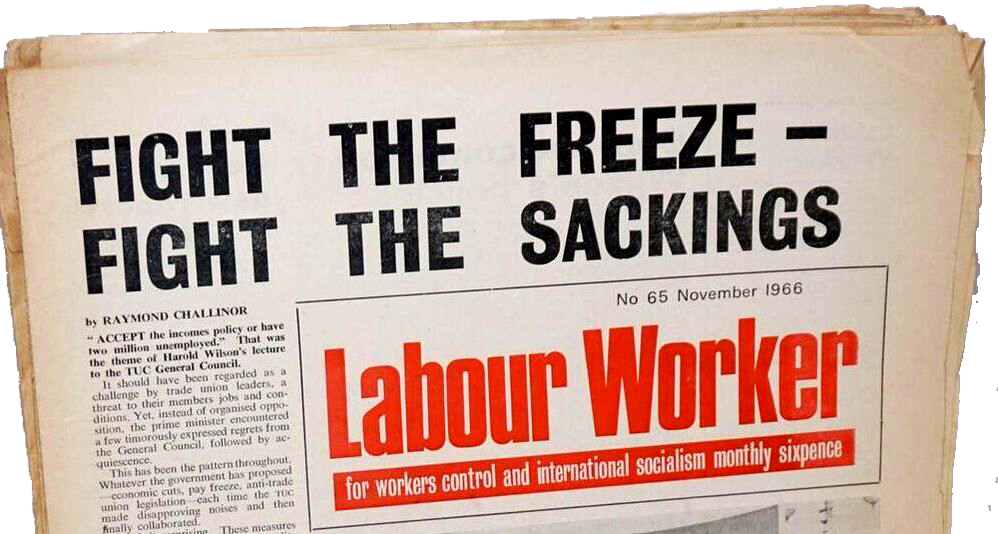
Soon after that meeting Paul joined the International Socialists. And soon after joining he took over editing their paper, the monthly Labour Worker. This was just four pages, with a print run of just 1500 copies, and sold for three old pennies. When Paul became editor in 1963 he was joined on the editorial board by Harry McShane and another Glaswegian Paul was close to, Bob Gillespie. Paul commissioned articles, organised their copy, wrote their headlines and did whatever editing was required before sending the paper to London to be typeset and printed.
Despite its meagre resources, Labour Worker’s pages teemed with articles by workers about their own industries and unions, as well as local and national strikes and campaigns. Even the occasional global event was addressed.
Paul left Glasgow in April 1964 and returned to London, where he continued to edit Labour Worker until the pressure of regular work, writing books and small children forced him to hand over the reins, although he continued to write for the paper. One of his most famous columns was his obituary of Winston Churchill.