Paul’s introduction to the case of James Hanratty happened in 1966, when he was sent by his editor at the Sunday Telegraph to cover an unusual burial. The body of James Hanratty, convicted of the A6 murder, was being moved from Bedford prison to a cemetery in Watford. ‘There may be trouble,’ the news editor anticipated.
The reason for the reburial was Parliament’s decision in 1965 to suspend capital punishment pending its abolition, a hotly contested political issue at the time.
There was no trouble, but Paul’s interest in the case was piqued by meeting Hanratty’s family and from then he helped them in their campaign for an inquiry into the facts surrounding their son’s conviction. Paul helped them establish the A6 Committee, an informal affair involving family and friends, including at different times some famous names, like the MP Fenner Brockway and John Lennon, at the time the most famous Beatle of all.
In December 1969, Lennon called a press conference and announced that he was planning to make a film about the Hanratty case. The film, Did Britain Murder Hanratty? was partly recorded at one of the huge public meetings organised by the A6 committee. It featured Hanratty’s parents Jim and Mary Hanratty on the platform at Watford Town Hall, and a very young-looking Paul Foot, already the clever public speaker that so many people remember.
At the end of the film, Jim Hanratty looks into the camera: ‘Beyond all doubt, in my mind, I am convinced that my son had no connection to this crime.’ Then his mother reads her son’s last letter, written to his brother: ‘Well, Mick, I am going to do my best to face the morning with courage and strength.’ And then he asked a favour of his brother: ‘Try and clear my name.’ It was almost daylight. ‘I have to say goodbye for now.’
James Hanratty was executed at eight o’clock in the morning on 4 April 1962.
Paul’s first article about their campaign was published in the glossy Queen magazine in September 1966. Then he worked alongside the BBC team making a Panorama programme. The publisher Tom Maschler had watched the programme and read the article and promptly wrote to Paul: ‘There is a terrific book in here.’
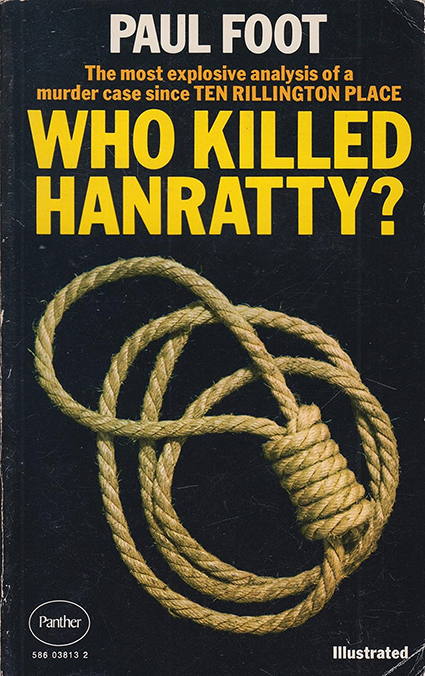
Who Killed Hanratty? was published in early May 1971, and extra copies were printed so that one could be sent to each member of parliament, and a good number to the House of Lords, with a letter pressing them to support an inquiry. Replies poured in, with Labour MPs generally supporting the call.
The case for an inquiry seemed overwhelming. The home secretary, whose decision it would be, was Reginald Maudling. He turned down the request.
Jim Hanratty was a proud man. He would argue his case at Hyde Park Corner, or stand with a placard outside the Home Office, never giving up the search for the truth about his son. Not many years later, when Jim was dying, Paul would visit in the evenings after work to do what he could to help. ‘Paul idolised my dad,’ says their other son Michael. ‘He was more than a journalist. He became a friend.’
In 1992, to mark the thirtieth anniversary of Hanratty’s execution, Yorkshire Television broadcast another documentary film, and another long dossier went to the home secretary. Again, a lengthy wait ensued, at the end of which the home secretary, Michael Howard, passed the buck to the newly formed Criminal Cases Review Commission. Eventually, in 2002, forty years after the hanging, the case did return to the Court of Appeal.