On 20 April 1968, Enoch Powell, Conservative MP for Wolverhampton South West, had made a dramatic speech on immigration to a Conservative Association meeting, in which he quoted an anonymous voter who claimed that, ‘in this country, in 15 or 20 years’ time, the black man will have the whip hand over the white man’.
How could he ignore this man, Powell asked: ‘I simply do not have the right to shrug my shoulders and think about something else.’ The indigenous population, he added – by which he meant white people – would be strangers in their own country. To drive the point home, he quoted the Roman poet Virgil: ‘As I look ahead, I am filled with foreboding. Like the Roman, I seem to see “the River Tiber foaming with much blood”.’
The speech made the headlines and shook the political establishment. Edward Heath immediately sacked Powell from the shadow cabinet; meanwhile, meat porters from Smithfield Market and dockers from Tilbury poured onto the streets and marched to parliament in Powell’s support.
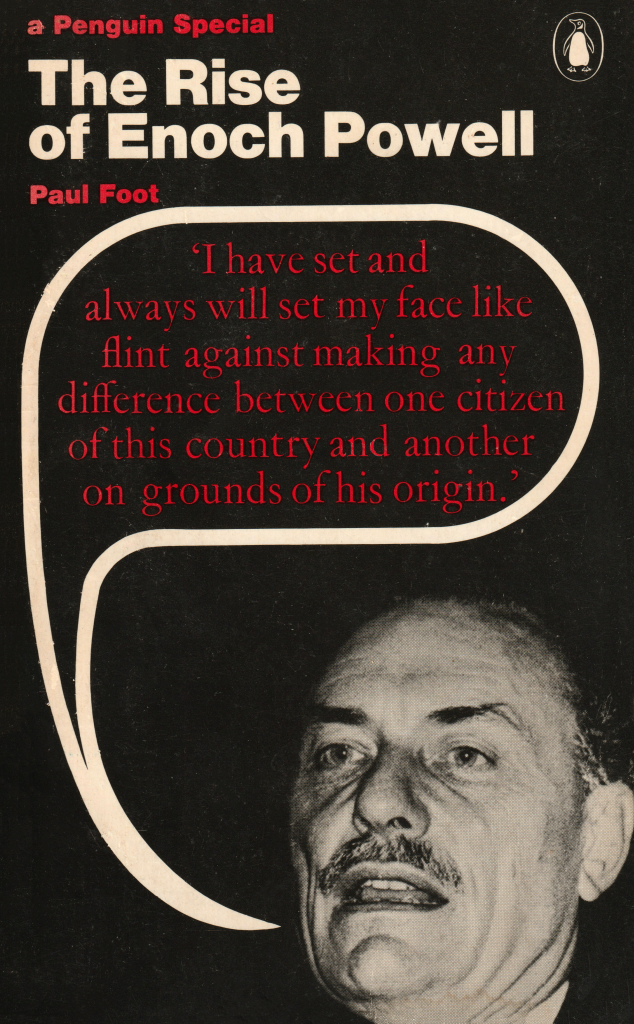
Penguin were very keen on Paul’s idea for a book about Enoch Powell, which would ‘provide ammunition for a counter-attack’.
Surprisingly, the book was written with Enoch Powell’s cooperation. A small item in the Evening Standard ‘Londoner’s Diary’ announced that ‘Paul Foot, irritant extraordinary and author of one of the most devastating political tomes of recent years, The Politics of Harold Wilson, is now turning his attention to that other bête noire of the extreme Left, Mr Enoch Powell.’ [Londoners’ Diary, ‘Foot’s feat’, Evening Standard, 18 February 1969.]
Enoch Powell must have seen the item, and immediately wrote to Paul offering help with articles, speeches and information. He was always punctilious.
This was a game of ‘Immigration Poker’, wrote Paul in the book, in which players had to raise the bid each time they played. What began as an argument about empire and citizenship became one about control, which then devolved into a question of control over numbers – in particular, numbers of black people. Powell’s final bid was in favour of repatriation. For a man who had written in his local paper in Wolverhampton during the 1964 election that he would set his face ‘like flint against making any difference between one citizen of this country and another on grounds of his origin’, this was something of a turnaround. But, in 1964, Powell had not yet started playing the game of Immigration Poker.
What had induced Powell to change course? Paul quotes another Conservative MP, who makes clear that Powell believed he was the right man to lead the Conservative Party. To be leader, to be chosen as the man who understood what people in the country wanted, he would play the immigration card and risk his whole career.
This was an extraordinary reversal for a man who had believed passionately in the British Empire as a force for good. But once the people of the empire had taken back their countries, the indivisible whole was broken. For Powell, the Commonwealth, as a group of independent countries, had little significance, and the notion of a common citizenship meaningless. His retreat from Grand Imperialist to Little Englander was complete.
Was Powell a racist? The question was reignited when Powell died in 1998. As so often, there were politicians – including Labour MPs – who were reluctant to speak ill of the dead, keen in this case to save Powell from his toxic legacy. This was odd, Paul thought, because by far the most important thing about Enoch Powell was that he was a racist. And that racism stemmed from his belief in capitalism and empire, ‘and with it an incontrovertible belief that the white man was ordained by god to conquer and control the world which was populated mainly by inferior black people’. [Paul Foot, “Beyond the Powell’, Socialist Review, March 1988.]