In one way or another, Paul had been thinking about the vote all his life, beginning in a rather unformed way in 1945, at the tender age of seven, when he sensed that something rather important had happened in the Labour landslide after the war.
The idea was simple – start with the history of how the vote was won, beginning with the Levellers and the idea that men should vote for their government, thrashed out in the debates between Oliver Cromwell and the army at Putney in 1647, where Thomas Rainsborough put the proposition that, ‘Every man that is to live under a government ought first by his own consent to put himself under that government.’ It was a new idea, to which Cromwell was wholly opposed.
Then Paul story would continue with the Reform Act of 1832, the ups and downs of the Chartist movement between 1838 and 1848, whose radical demands were ultimately met with failure, and on to the suffragettes.
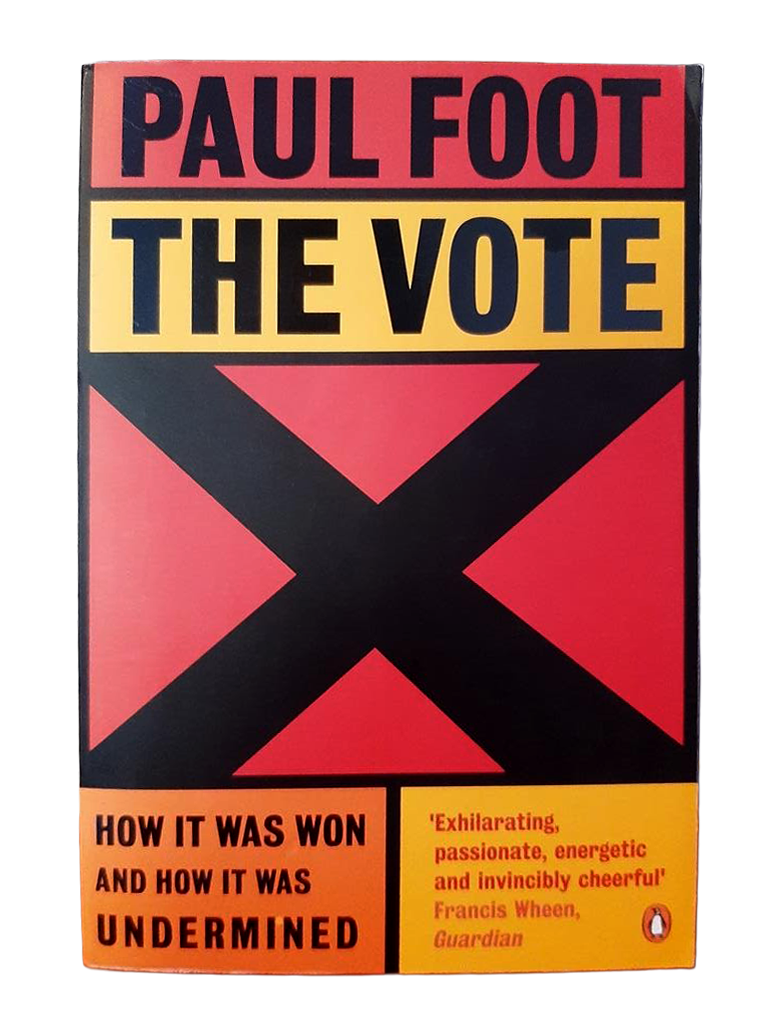
When Paul was carted off to hospital with the life ebbing out of his heart in 1999, four chapters of his book were with his publisher, and he was on to the familiar territory of votes for women. His mind was so focused on the chapter that, even after that near-death experience, he was working on it again before he left hospital.
That chapter concluded the first part, on how the vote was won. Next, Paul turned his attention to what really intrigued and bothered him: how the long struggle for the vote had ended up in a parliamentary cul-de-sac of impotence. ‘Why were elected politicians committed to socialist ideas so palpably incapable of putting them into practice?’ he asked in the introduction. Why had elected socialists been so pathetic in office?
Again, he worked his way through the history of those decades: the utter failure of two Labour administrations under Ramsey MacDonald; the inspiration of politicians like George Lansbury; the arguments of R.H. Tawney, that political power was nothing without economic power; the Second World War and the 1945 Labour Government, under Clement Attlee; Harold Wilson and finally Tony Blair.
By the time Paul was labouring with the final chapter of The Vote, he was writing about contemporary events: ‘New Labour is the rejection of social democratic politics’, he told his audience at Marxism in 2003. ‘State pensions, gone, council housing, gone, comprehensive education, gone, public transport, gone, and even the diamond in the social democratic crown, the NHS, being pinched and lessened.’
‘Systematically and with tremendous application and dedication,’ he wrote in the introduction to Labour Party PLC, ‘New Labour had striven to tear up the roots left by Old Labour and to turn itself into a business party every bit as credible and friendly to big business as the Tories had been.’
The cost of tearing up the roots would be high:
‘Where there is no difference between two big political machines paid for by big business, ordinary peoples’ interests in and involvement in politics collapses. Less people vote and less people care. All politics becomes contemptible, and the way is open for the racialist and the dictator.’ [David Osler, Labour Party PLC: New Labour as a Party of Business, Foreword by Paul Foot (Edinburgh, 2002), p. 10.]